
Workforce Planning
Plan for the workforce you'll need.
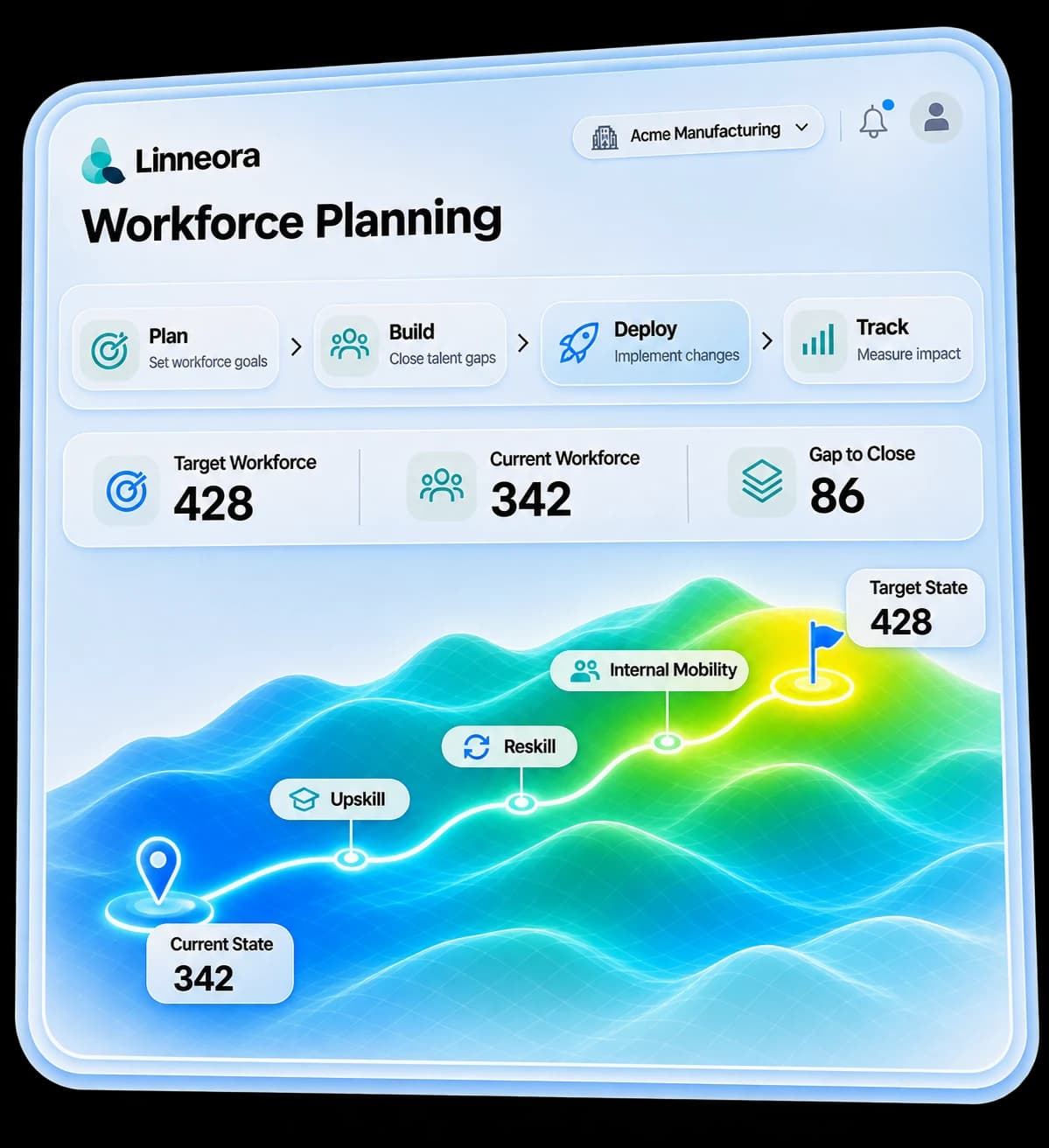
Workforce planning starts with a question about the work: what can the organisation do now, what will it need to do next, and where are the differences? Linneora brings role, skill and market evidence into that conversation.
Why workforce plans drift from the work
Workforce plans often begin with a headcount spreadsheet. The spreadsheet records how many people sit in each team, but not what those teams can do, which capabilities are concentrated in a few people, or which requirements are changing.
When the business changes, the plan is rebuilt from the same labels. Roles are added or removed, but the underlying question, whether the organisation has the capabilities it needs, remains hard to answer.
Headcount is an output, not the question
The number of people needed follows from the work and the capabilities it requires. Starting with headcount can make the plan look precise while leaving the important assumptions unexamined.
Plans age quickly
Business requirements, technology and roles change. A plan built on a static role list has to be rebuilt whenever the organisation changes, instead of being updated as the evidence improves.
Understand the capabilities you have
A clear view of current capability depends on a consistent description of roles, skills and levels. Job architecture and standardised profiles give every role a comparable shape, so the picture does not depend on which team supplied the spreadsheet.
The view should also show where evidence is thin. A capability may be recorded but rarely used, concentrated in one location, or described differently across teams. Those are questions for the plan, not reasons to ignore the data.
Roles and skills together
Roles show where work sits; skills show what the work requires. Reading them together helps distinguish a team that is fully staffed from one that depends on a single specialist.
Concentration and dependency
Capabilities can look healthy in total and still be fragile if they sit with one person, one site or one team. Concentration is a planning signal that a headcount total cannot show.
Illustrative example: from a business change to a capability question
This example is illustrative, not a real organisation. It shows how a change in requirements can be turned into a planning question without starting from a headcount target.
- Current capability
- What the organisation can doA team with deep process, quality and supplier coordination skills, concentrated in one site.
- Future requirement
- What is changingA new operating model needs the same work to be coordinated across two sites, with clearer ownership of standards.
- Question to explore
- What the plan needs to testWhether the capability can be shared without losing depth, and where the organisation would need to build or bring in additional expertise.
The example does not produce a headcount number. It produces a clearer set of questions about capabilities, concentration and evidence.
Identify future needs and explore gaps
Future needs come from changes in the business: new products, different operating models, technology, regulation or customer expectations. Translating those changes into roles, skills and capabilities is the work that makes a plan useful.
The gap is the difference between what the organisation can do now and what it will need to do. It is rarely a single number. It may be a shortage of a specific skill, a capability that does not exist yet, or a role whose responsibilities are shifting.
Capabilities before headcount
Describing the future in capabilities gives planning teams something they can compare with the current picture. Headcount can then follow from the work, rather than standing in for it.
The gap is a question, not a verdict
A gap points to a decision: build the capability, bring it in, partner for it, or change the work. The evidence should make the options visible without pretending the choice is automatic.
How Linneora supports workforce planning
Linneora connects the foundation to the planning question. Job architecture and standardised profiles describe current roles and skills. Market context and supply and demand intelligence add the external view. Together they show where the organisation is strong, where it depends on a small group of people and where the market may constrain a plan.
The result supports the questions planning teams already ask: which capabilities need attention, where a gap may open, and which assumptions need better evidence. It informs the plan; it does not replace the people who own it. Linneora does not set budgets, approve headcount or run HR processes.
From workforce plan to broader decisions
A workforce plan becomes more useful when it connects to the decisions around it. Organisation design can use the same role structure to compare structures. Talent supply and demand can test whether a location can support the plan. AI transformation can examine how changing tasks alter the capabilities the plan assumes.
Each decision uses the same foundation, so the plan stays connected to the evidence as it changes. That is the difference between a plan that is rebuilt each year and one that can be explained, challenged and improved.
Ready to explore?
Plan from the capabilities you have
See how Linneora connects roles, skills and market context to support workforce planning.