
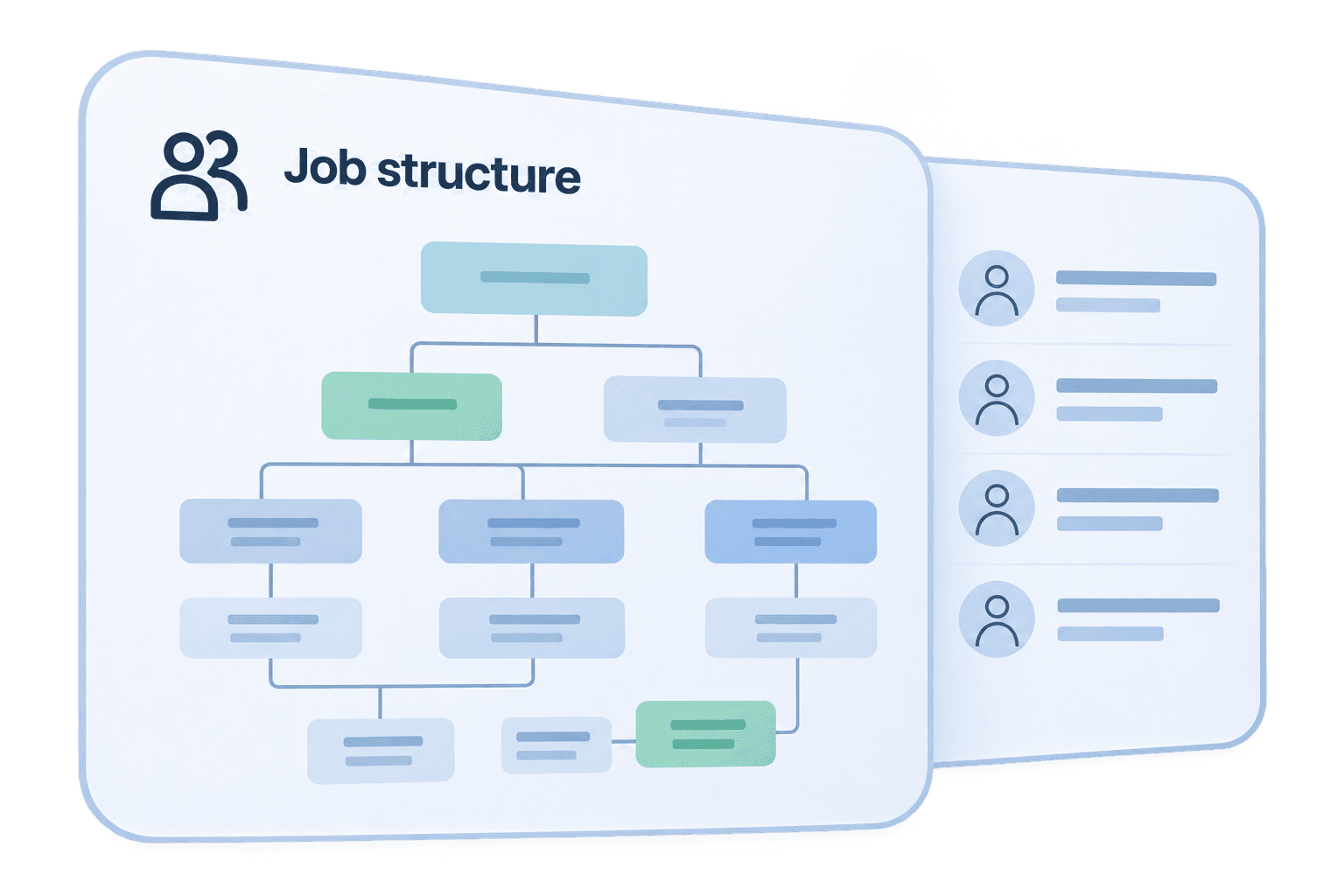
The situation
The group began as a single production site and now runs four, two of which joined through acquisition. Each site has kept the titles that made sense locally. One calls its experienced operators “Operations Leads”, another uses “Senior Production Technicians”, and a third has “Shift Support Specialists” who do much the same work.
The central HR team is small. It can see every employee record, but the records describe people in the language of the site that created them. The group has a payroll system, an HR system and a set of local job descriptions. What it does not have is one agreed way to describe a role.
Site managers needed titles that reflected local responsibilities and made sense to their teams. The difficulty is that the group now has to answer questions that cut across sites.
How the problem develops
Acquisitions brought more than equipment and customers. They brought job families, pay structures, performance language and a set of assumptions about what a particular title means. Rather than impose a new structure during integration, the group let each business keep its own. That was pragmatic, and it kept the integration quiet. It also meant that the same title could carry different levels of responsibility in different places.
Local recognition added another layer. A title is often used to reward experience or signal seniority, even when the underlying work has not changed. Over time, the labels drifted away from the roles they were meant to describe. The HR system stores the label and the reporting line. It does not store the purpose of the role or the capabilities it requires.
The group also inherited different ideas about what a level means. A senior technician at one site may supervise a shift, while a senior technician at another may be the most experienced person on a small team without managing anyone. They are not interchangeable.
What it looks like in practice
On a Monday morning, the central HR team prepares a workforce summary for the group leadership meeting. The operations director asks how many experienced production staff the group has. The team can produce a number for each site, but the numbers are not comparable. One site counts team leaders separately. Another includes contractors. A third has two people with the same title doing different jobs.
Later that week, a manager wants to move an experienced operator from one site to another. The move looks straightforward on paper. In practice, the receiving site cannot tell whether the person has the right level of accountability, and the salary band does not map cleanly. The conversation becomes about titles rather than work.
Training and succession planning run into the same problem. The group cannot see where similar capabilities sit, so it treats every site as a separate workforce. The people involved are not short of experience. The organisation is short of a way to describe it.
Why it matters
Without a shared structure, workforce reporting becomes a count of labels. That makes it difficult to compare roles, identify where scarce capabilities sit, or explain why two people with the same title are paid differently. It weakens planning. A decision to consolidate a process or move work between sites depends on knowing which roles are genuinely equivalent.
The longer the inconsistency remains, the more it becomes part of the organisation's operating habits. New titles are added to fit new situations, and the gap between the label and the work widens. A job architecture gives the group a way to keep local meaning while making roles comparable. It does not require every site to use the same words. It requires the organisation to agree what the words are describing.