
AI Transformation
Understand how AI could reshape your workforce.
AI transformation is often described as a change in the number of jobs. In practice, it usually begins with tasks, responsibilities and the skills a role needs. Linneora helps you examine those changes with the roles you already have.
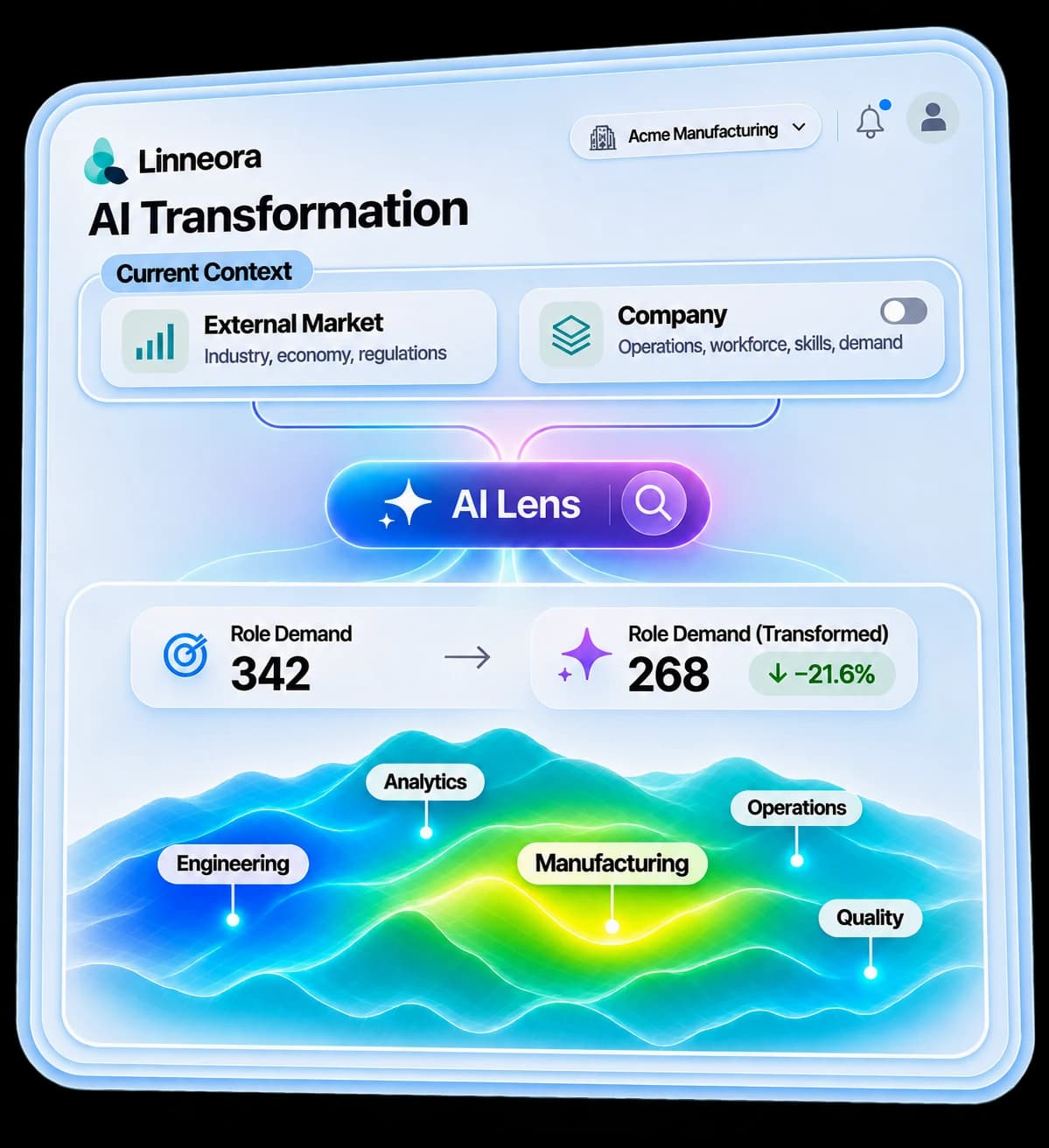
Why AI changes tasks before it changes org charts
A role is a bundle of tasks, responsibilities and expectations. AI can change parts of that bundle without changing the role's title or its place in the organisation. A report may be drafted faster, an analysis may be assisted, a customer interaction may be supported. The role remains, but the work inside it shifts.
Because the change starts at task level, a workforce view that only counts roles can miss it. The first useful question is not how many roles will disappear, but which parts of which roles are likely to change.
Start with tasks
Task-level examination shows where AI may take over routine work, where it may support judgement, and where it may create new work such as reviewing, validating or integrating outputs.
Change is uneven
Roles with similar titles can have different task mixes, especially in company-specific roles. The implications depend on the work, not only on the label.
What may change in a role
AI can affect a role in several ways at once. It may automate a task, accelerate part of a task, change the skills needed to do it well, or shift responsibility for checking and deciding. It may also create new tasks that did not exist before.
The useful question is which of these changes is plausible for a given role, and what evidence supports that view. That is different from assuming a single outcome for every role.
Augmentation and automation
Some tasks may be handled largely by a system; others may be done faster with assistance while a person remains accountable. The distinction matters because it changes the skills and judgement the role still needs.
New skills and shifted responsibilities
When part of a task is automated, the remaining work can become more specialised. People may need to interpret outputs, manage exceptions or take on work that was previously elsewhere.
Illustrative example: examining one role through an AI lens
This example is illustrative, not a real organisation. It shows how a role can be examined task by task without assuming a single outcome.
- Task
- What the role doesPrepare a weekly performance summary from several operational reports.
- Possible shift
- What may changeThe summary may be assembled faster with AI assistance, while judgement about what the numbers mean remains with the role.
- What to examine
- The workforce questionWhether the role needs different analysis and validation skills, and whether the time released can be used for work the organisation currently lacks.
The example does not predict whether the role will grow or shrink. It shows the kind of evidence a workforce conversation needs before that question can be answered.
From role impact to workforce requirements
Examining AI at role level turns a general conversation into a set of specific questions. Which roles contain a high share of tasks that may change? Which skills become more important? Where might demand for a capability rise or fall? Which teams depend on a task that is likely to be automated?
The answers are provisional. AI adoption depends on the organisation, the work and the evidence available. The value of the view is that it makes the assumptions visible and comparable across roles, teams and locations.
A role-level view
A consistent job architecture lets the same role be examined across teams and locations. Without that structure, every AI question rebuilds the role list and produces a view that cannot be compared.
Evidence, not certainty
The aim is not to predict the future precisely. It is to show where the evidence points, where confidence is lower and which questions need to be tested before a workforce decision is made.
How Linneora approaches AI transformation
The Linneora AI Transformation view is exploratory: it examines how AI may affect roles, tasks and skills. It builds on the job architecture and skills taxonomy, then looks at role demand and capability implications alongside the current context. The view is intended to support investigation, not to present a finished answer.
Because the analysis starts from your roles and skills, it can include niche and company-specific roles that generic AI studies overlook. The output is a structured set of questions about tasks, capabilities and workforce requirements.
Connect AI change to workforce planning
AI transformation does not sit apart from workforce planning. If tasks and skills may change, the plan's assumptions about future capabilities change with them. Job architecture provides the stable reference point; workforce planning turns the implications into questions about roles, skills and gaps.
The point is to understand the shape of change, not to assume a reduction. Some roles may need different skills, some may grow, and some may change in ways that are not clear yet. A traceable view helps leaders examine those possibilities without presenting uncertainty as certainty.
Ready to explore?
Examine AI change with your roles
See how Linneora connects role structure and workforce intelligence to support AI transformation questions.