
Talent Supply & Demand
Understand where talent supply meets demand.
Talent supply and demand are rarely one number. Availability, competition and location differ by role and skill. Linneora brings those signals together, so you can ask a more specific question than whether a title is common.
Why a single supply and demand number misleads
Aggregate market reports can tell you that a role is growing or that skills are scarce. They rarely tell you whether the people who do that work are near your sites, whether competing employers recruit for the same combination of skills, or whether the title you use describes the same work elsewhere.
The problem becomes sharper for niche and company-specific roles. A role may combine engineering, quality and operations skills in a way that no standard occupation describes. Counting people who hold a similar title can understate the available talent or overstate the competition.
The same role looks different by location
A capability can be deep in one region and thin in another. Location changes both the available talent and the number of employers competing for it, so a national view can hide the constraint that matters.
A title count is not a capability count
People with different titles may hold the skills a role needs, and people with the same title may do very different work. Comparing skills and role context gives a more useful signal than comparing labels.
What supply and demand can help you investigate
A useful supply and demand view answers questions about availability, competition and geography together. It shows where the talent for a role or skill appears to be concentrated, where demand is higher, and how that balance changes across locations.
The view is a starting point for investigation, not a verdict. It helps you decide where to look more closely, which assumptions to test and which parts of the picture rest on thinner evidence.
Availability
Look for the skills and role context that matter, not only the job title. The question is whether people who can do the work are present in the places you are considering.
Competition
The same talent pool may be shared with other employers. Competition adds a second dimension to availability: it is possible for talent to exist in a location and still be hard to attract.
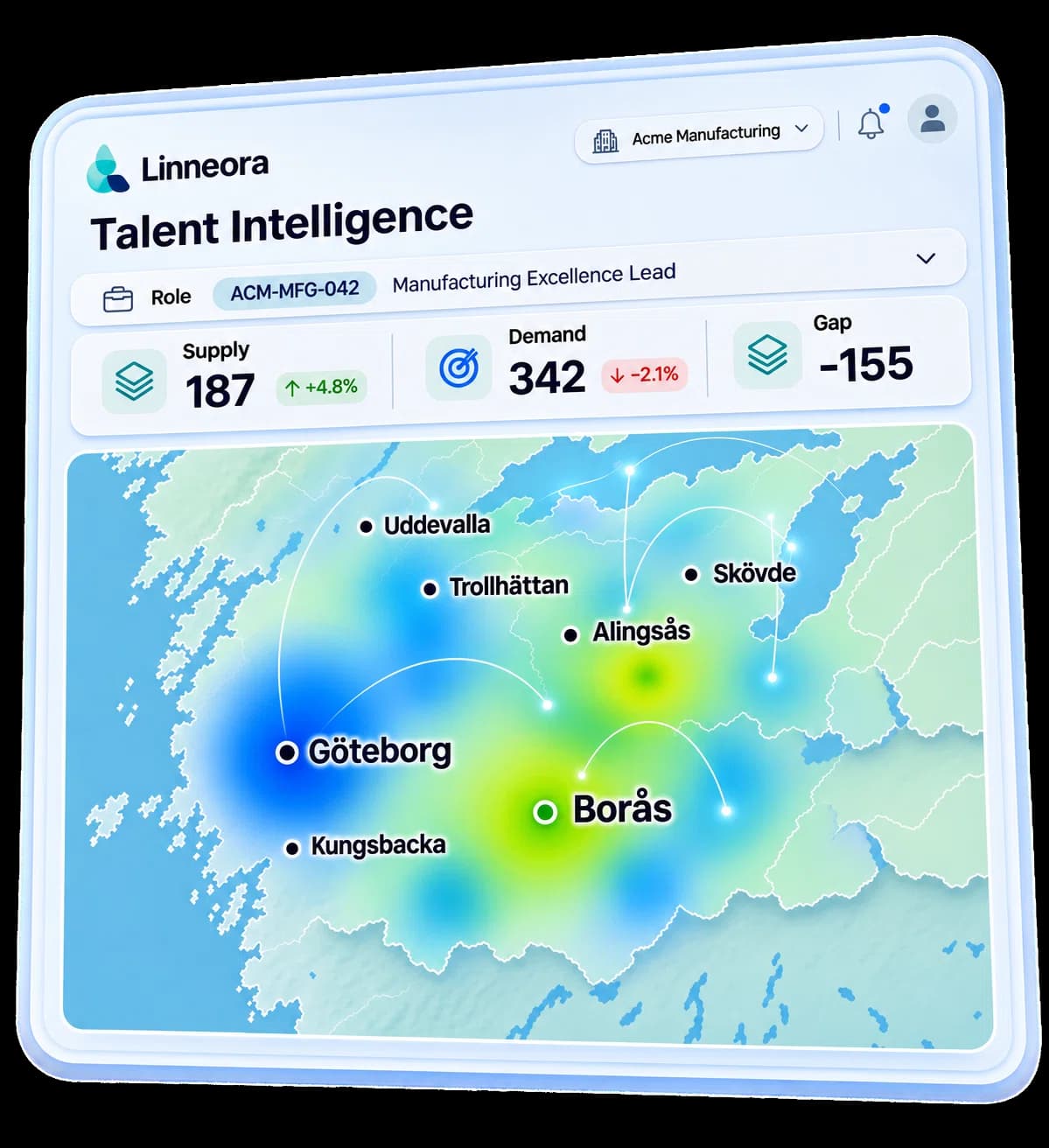
Illustrative example: one niche role, three questions
This example is illustrative, not a real organisation. It shows how a company-specific role can be explored without reducing it to a standard job title.
- The role
- Manufacturing excellence leadA company-specific combination of engineering, operations and quality skills, defined by the work rather than by a standard occupation.
- Availability
- Where the skills appearThe component skills may be present in several teams and locations, even when no one holds the exact title.
- Competition
- Who else is lookingEmployers nearby may recruit for overlapping skills, so availability alone does not tell you how hard the role will be to fill.
Each question changes the next one. The aim is not a single score, but a clearer view of where the talent is, what the competition looks like and which assumption needs better evidence.
Niche and company-specific roles need a closer look
Standard frameworks such as ESCO and O*NET provide a shared vocabulary for skills and occupations. They are useful for comparison, but they do not know what a manufacturing excellence lead means in your organisation, which capabilities the role combines, or why it exists.
Linneora maps your roles and skills to that shared vocabulary while keeping your titles and local meaning. That makes it possible to investigate a role that sits between standard categories without flattening it into the nearest match.
Skills as the bridge
A skill-level view can connect a company-specific role to comparable work elsewhere. It shows which parts of the role are widely available and which combination is harder to find.
Evidence and confidence
Some locations and skills have richer data than others. Missing data lowers confidence, not usability. The view should make clear where evidence is strong and where it needs improvement.
How Linneora approaches talent supply and demand
Linneora starts with the workforce data you have, even when it is messy. It builds a consistent job architecture and skills taxonomy, then connects that foundation to market context built on sources such as ESCO, O*NET and Eurostat.
Supply, demand and geography sit together in one view. You can explore a role, a skill or a location, see the gap between available talent and demand, and trace the context behind the result. External data informs the picture; it does not define your demand.
From market signal to workforce decisions
Supply and demand intelligence is most useful when it connects to a decision. A hiring team can compare locations before opening a role. A workforce planner can see where a capability gap may grow. A job architecture team can check whether a role definition is attracting the right comparison.
The evidence does not make the decision. It gives hiring, location and skills conversations a shared reference point, and shows where a plan depends on an assumption that still needs testing.
Ready to explore?
Start with the roles you need to understand
See how Linneora connects your roles and skills to supply, demand and location.